Acacia Systems is advancing Onyx, its passive sonar automatic detection, tracking and localisation capability, to deliver enhanced tracking performance across a wider range of challenging acoustic environments.
The collaborative project with UNSW is supported by funding from Defence Trailblazer’s Advanced Innovation Fund, with a direct cash contribution of $5 million and an in-kind contribution of $15 million AUD from Acacia. The project represents over 25 years of investment in research to develop a critical sovereign capability.
Acacia’s Onyx is a sensor-agnostic passive technology that automatically detects acoustic signatures in underwater environments without transmitting signals. Cluttered underwater environments present challenges for detecting and tracking weaker acoustic signals.
This project will advance Onyx’s current world-class capability in these challenging environments by developing high resolution signal processing methods to extract meaningful temporal and spectral features from acoustic data. These methods can extract more informative features for improved target identification and tracking.
“These techniques will improve the detection and tracking of weak, intermittent, and transient signals that current energy-based methods miss,” said Acacia Chief Research Engineer Ted Bullen.
UNSW Sydney researchers, led by Associate Professors Beena Ahmed and Vidhyasaharan Sethu, will develop advanced pre-processing, feature extraction, and encoding techniques for sonar data that is high-resolution beamformed (a technique used for directional signal reception). The project will also evaluate distance metrics to ensure the new features integrate seamlessly with Acacia’s existing data association and tracking framework.
“We will investigate how to pre-process acoustic data to extract features that go beyond conventional energy-based detections,” said Associate Professor Ahmed. “This work will preserve critical temporal and spectral information to ensure robust integration with Acacia’s current tracking algorithms.”
The Onyx technology is already supporting Defence’s contributions to the whole-of-government Operation Resolute effort by delivering a capability that integrates acoustic data streams from multiple different sources, including sonar buoys, fixed systems and thin line arrays (TLAs). It is expected that research will inform related progress in deploying Onyx capabilities on Ocius Technology’s Bluebottle uncrewed surface vessels. This makes the project ideally placed to contribute to the Navy’s future autonomous undersea warfare capabilities.
“We are building a symbiotic relationship between the core research threads in this project and the progressive capabilities deployed to the RAN under Acacia’s Capability-as-a-Service model,” said Acacia Chief Executive Officer Bob Humphreys.
Dr Margaret Law, General Manager – Technology Development & Acceleration at Defence Trailblazer, said of the project: “We are excited to support the integration of capabilities of two of our industry partners, Acacia Systems and Ocius Technology, in a project that directly aligns with the anti-threat submarine detection and localisation priority challenge set out in the 2026 Integrated Investment Program.”
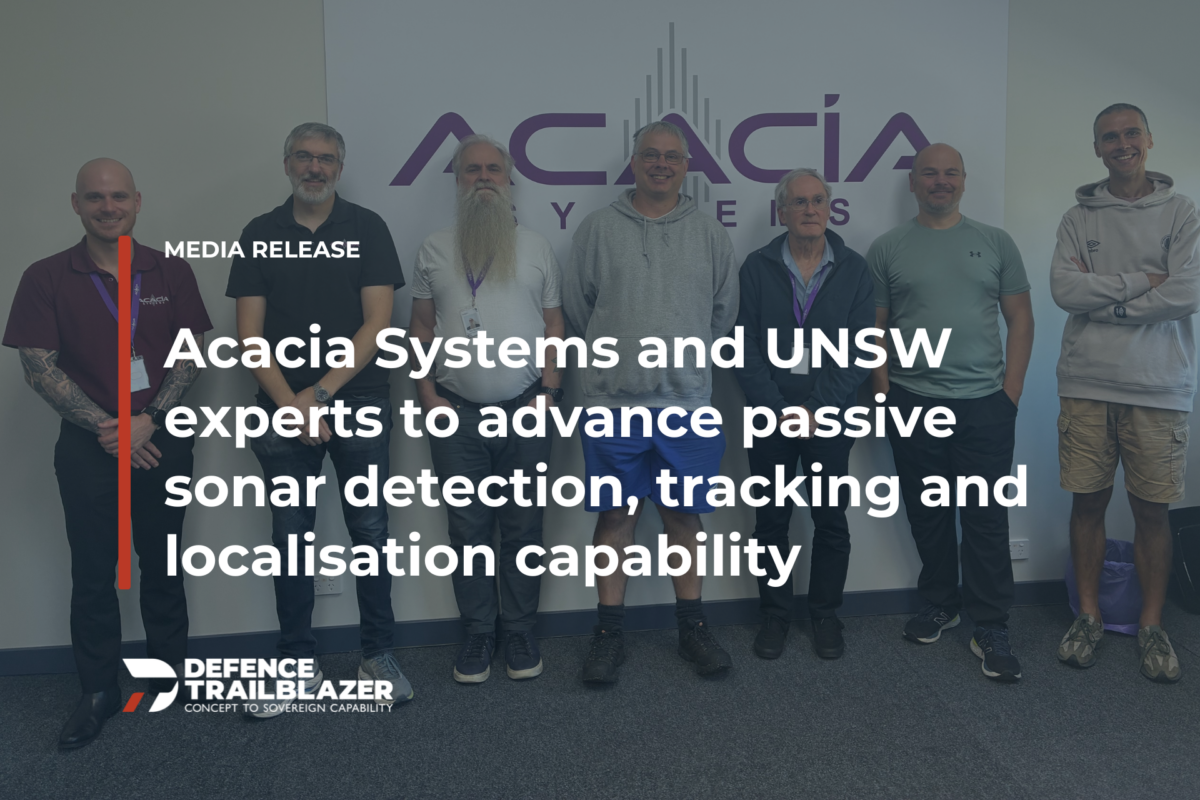
Title image shows Acacia Systems project team (from left to right): Hayden Cluse, Project Manager; John Scott, Senior Software Engineer; Ted Bullen, Chief Research Engineer; Paul Gardner-Stephen, Principal Systems Engineer; Chris Hartley, Senior Systems Engineer; Adam Zielinski, Test Engineer; Milan Mijajlovic, Software Engineer.