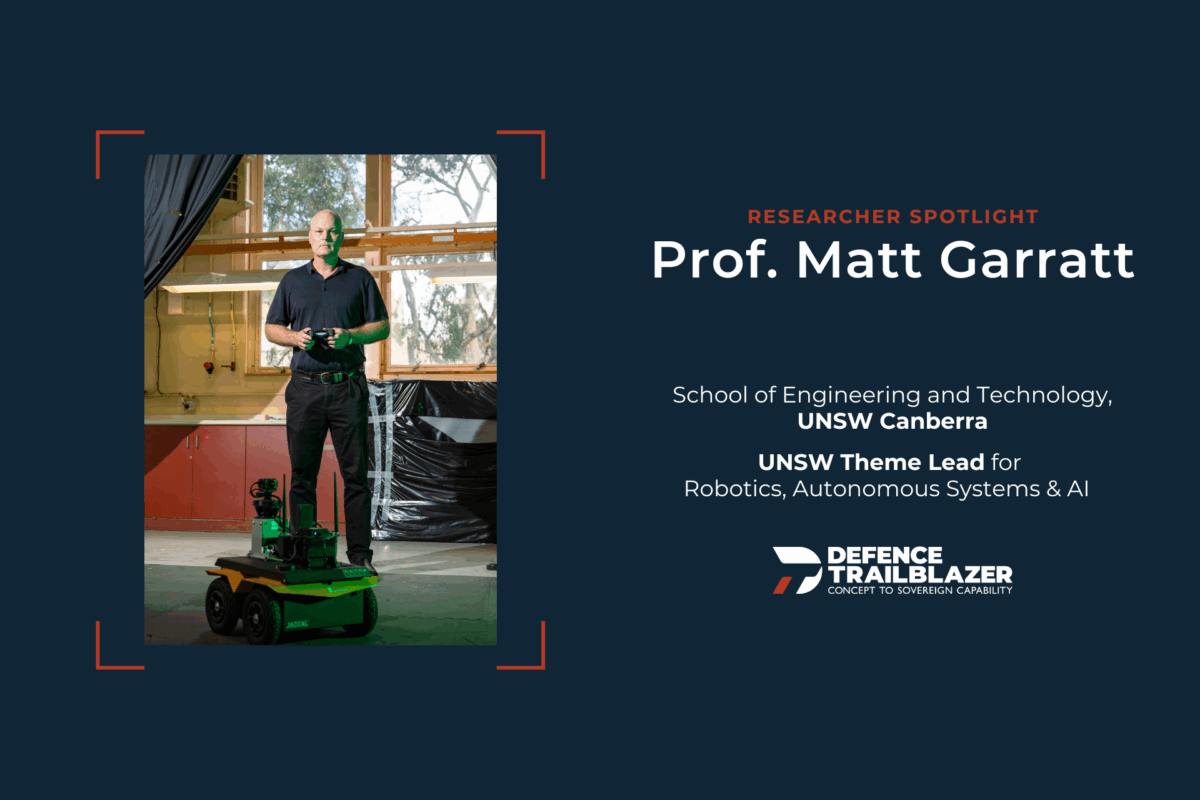
Professor Matt Garratt
School of Engineering and Technology, UNSW
Deputy Director (Defence & Security), UNSW.ai Institute
Defence Trailblazer Theme Lead for Robotics, Autonomous Systems & AI (RASAI), UNSW
Professor Matt Garratt leads the Defence Trailblazer’s UNSW team for Robotics, Autonomous Systems and Artificial Intelligence (RASAI).
RASAI capabilities
“RAS-AI is a bundle of disruptive technologies that must be engaged to stay ahead of our adversaries and ensure future security,” says Professor Garratt, who is based at the Australian Defence Force Academy (ADFA) campus in Canberra.
Professor Garratt’s work focuses on sensing, guidance and control for autonomous systems. He is the co-founder of the AIR Lab at UNSW Canberra, which is dedicated to advancing AI and Robotics by developing innovative solutions.
His current research projects include achieving autonomous flight in cluttered environments using monocular cameras and range sensors, landing UAVs on moving platforms, adaptive flight control for flapping wing and rotary wing vehicles, and self-organising swarms of UAVs.
“Where I work at UNSW Canberra, we have a unique microcosm representing all of the key focus areas of Defence Trailblazer. This allows me to not just work in RASAI but also dabble in other fields such as hypersonics, space and cyber, which also have a big cross-over with RASAI.
I see my role as Theme Lead as helping to match-make between academics and industry, to leverage our expert knowledge, experience and infrastructure to achieve project goals.”
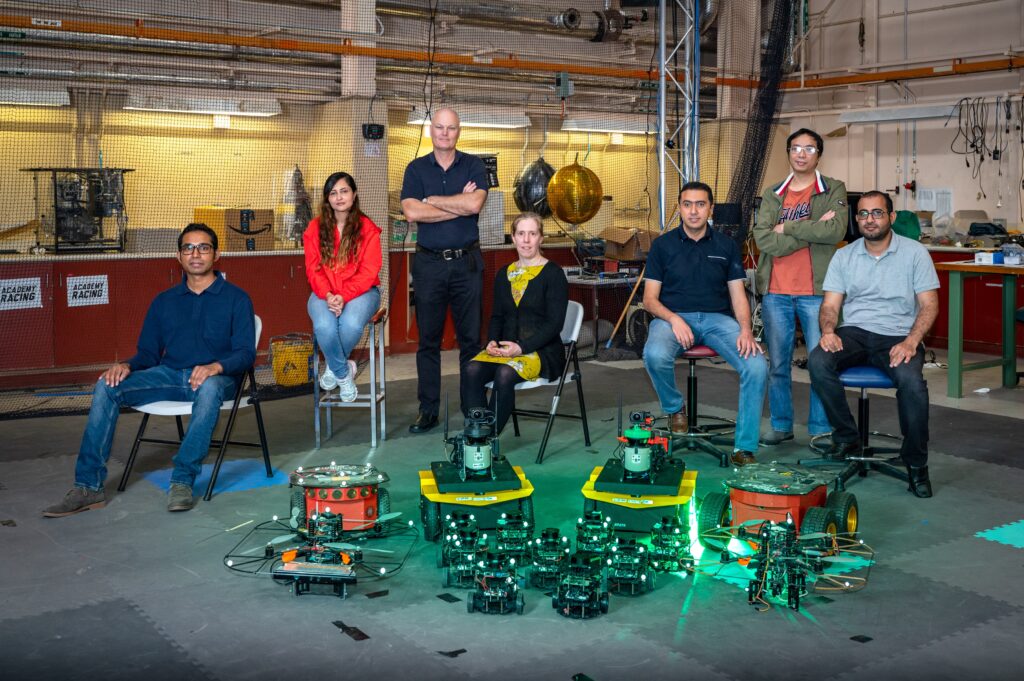
AIR Lab members photographed at UNSW Canberra. Pictured from left: Dr Asanka Perera, Dr Shadi Abpeikar, Professor Matt Garratt, Professor Kathryn Kasmarik, Dr Essam Debie, Dr Phi (Vu) Tran, Mr Ammar Mahdi (PhD Candidate).
Research that serves Defence
“Australia has an amazing pool of talent in areas that serve our Defence interests.
In Defence, we have had on over-reliance on foreign research and development (R&D) and industry to provide our capability. In a world that is growing more and more uncertain, this dependence on other nations to innovate the technologies we need for security, places us at growing risk.
Growing sovereign capability through Defence-related research will not only make us safer but also have spin-offs to many other applications with the potential to really boost the economy.
Defence Trailblazer presents significant opportunities for industry and academia: enabling and accelerating the transition of ideas to actual products, helping to enable the growth of next-generation researchers and developers, and enhancing Australian capabilities in RASAI.”
Background
A graduate of the Australian Defence Force Academy, Professor Garratt served in the Royal Australian Navy from 1987–1997. Since 2001, he has been employed as a lecturer in control theory, rotary wing aerodynamics and flight dynamics. He currently supervises five postdoctoral fellows and 14 PhD candidates, including one student through the Defence Trailblazer Industry Research Program (IRP).
During his academic career, he has been a Chief Investigator on 33 research grants, with external funding from sources including the Australian Research Council, Defence Science and Technology Group, US Army, US Air Force, US Navy, NASA and the UK Ministry of Defence.
Professor Garratt is an active member of the IEEE Computational Intelligence Society. He chaired the Task Force on the ethics, social and legal implications of computational intelligence from 2017-2020, and was recently an associate editor of the IEEE Transactions on Artificial Intelligence and the IEEE Robotics and Automation Letters. For the past three years, Professor Garratt has been the Deputy Director – Defence & Security for the UNSW.ai Institute for AI, Data Science and Machine Learning.

Dr Tran Nguyen and Professor Garratt (pictured with a drone) are researching efficient strategies for visually guided flight at UNSW Canberra.