Saab Australia and academic experts from the University of Adelaide and UNSW are developing a strategic planning tool for maritime defence to respond to advanced threats.
Powered by artificial intelligence (AI), the planning and decision support tool is designed to enhance the Royal Australian Navy (RAN) to conduct its operations, with a specific focus on optimising defensive postures against hypersonic threats.
The challenge
Geopolitical challenges in the Indo-Pacific are continually evolving, and the Australian Defence Force and its allies are actively monitoring emerging threats and reinforcing regional stability. Advanced threats like hypersonic missile proliferation and information uncertainty present challenges that can affect decision superiority over adversaries.
“The challenge is the RAN’s ability to maintain decision superiority and respond optimally at operational tempo, which is increasingly pressured by the complex, contested Indo-Pacific maritime environment,” said project academic lead, Dr Tim Chen from the University of Adelaide.
The solution
The project investigators are developing the strategic maritime planning tool to assist RAN personnel – Commanding Officers, Principal Warfare Officers and their staff – in making optimal decisions within the Rules of Engagement and mission objectives.
The goal is to enhance naval commanders’ dynamic response and mission execution for enhanced naval capability. Specific use cases include optimised defensive postures and resource employment against advanced threats, including hypersonics, and the mitigation of risks associated with operator stress or experience.
The real-time decision support is intended to improve decision superiority, especially under “fog of war” pressure. It also provides a powerful training and mission rehearsal tool.
Powered by AI and machine learning, the tool would integrate and analyse diverse data – including real-time sensor feeds, multi-source intelligence, environmental data, logistical status, and own-force readiness – while accounting for inherent data uncertainty and incompleteness.
The tool is intended to provide continuous threat assessment, with an interface based on intuitive visualisations. It also facilitates Course of Action wargaming, recommends resource allocation, offers real-time decision support, evaluates readiness, and ensures Rules of Engagement compliance.
“The aim is ultimately contributing to a more agile, effective, and resilient maritime force,” said Dr Chen.
The project
Phase One of the project, which was completed in April 2025, explored current doctrine in the field of decision support tools, and developed an operational concept and a set of high-level needs. The project team also considered analogues for this capability from time-critical environments in other domains.
Phase Two will commence in July 2025 and will develop a high-level prototype and a set of scenarios against which it can be tested.
“The value proposition lies in enhancing decision superiority, particularly under pressure; optimising resource employment against advanced threats; and enabling faster adaptation through information feedback loops,” said Mr Fairall.
The team
The project is led by Dr Dennis Medlow, Innovation & University Engagement Manager at Saab Australia. Scott Fairall, Naval Operations subject matter expert at Saab Australia brings over 30 years of experience to the team having worked in Naval Operations and combat related functions, as an Ex- Royal Australian Navy Warrant Officer. Key technical and operational input from other Saab staff harnesses the organisation’s 35+ years of experience in Naval operations.
The academic leads on the project are human-centred AI systems researcher Dr Tim Chen from the University of Adelaide and maritime historian Professor Richard Dunley from UNSW, providing strategic insights. Dr Chen and Professor Dunley have been engaged through the Defence Trailblazer’s Staff Mobility Program, which embeds academics in industry.
Investigator profile: Dr Tim Chen
 Senior Lecturer, School of Computer and Mathematical Sciences, University of Adelaide
Dr Chen’s research focuses on engineering interactive systems with emerging technologies to augment knowledge worker capabilities. “My background in engineering human-centred AI systems is geared towards creating AI that is transparent, reliable, and effective with human decision-making,” said Dr Chen.
After joining the University of Adelaide in 2020, he established the Human-Computer Interaction lab focusing on the engineering of human-centred AI. He also serves as the University of Adelaide’s research lead for the Augmenting Ability CRC, developing adaptive AI for aged and disability care.
Dr Chen has applied his expertise to several projects in situational awareness and force design with Defence Science Technology Group. “Defence represents a critical domain for effective human-AI collaboration, where operator trust in AI is paramount for operational success,” said Dr Chen.
“This Defence Trailblazer project with Saab Australia presents an exciting opportunity to apply these human-centred principles to a complex Defence challenge—a prospect that genuinely interests me.”
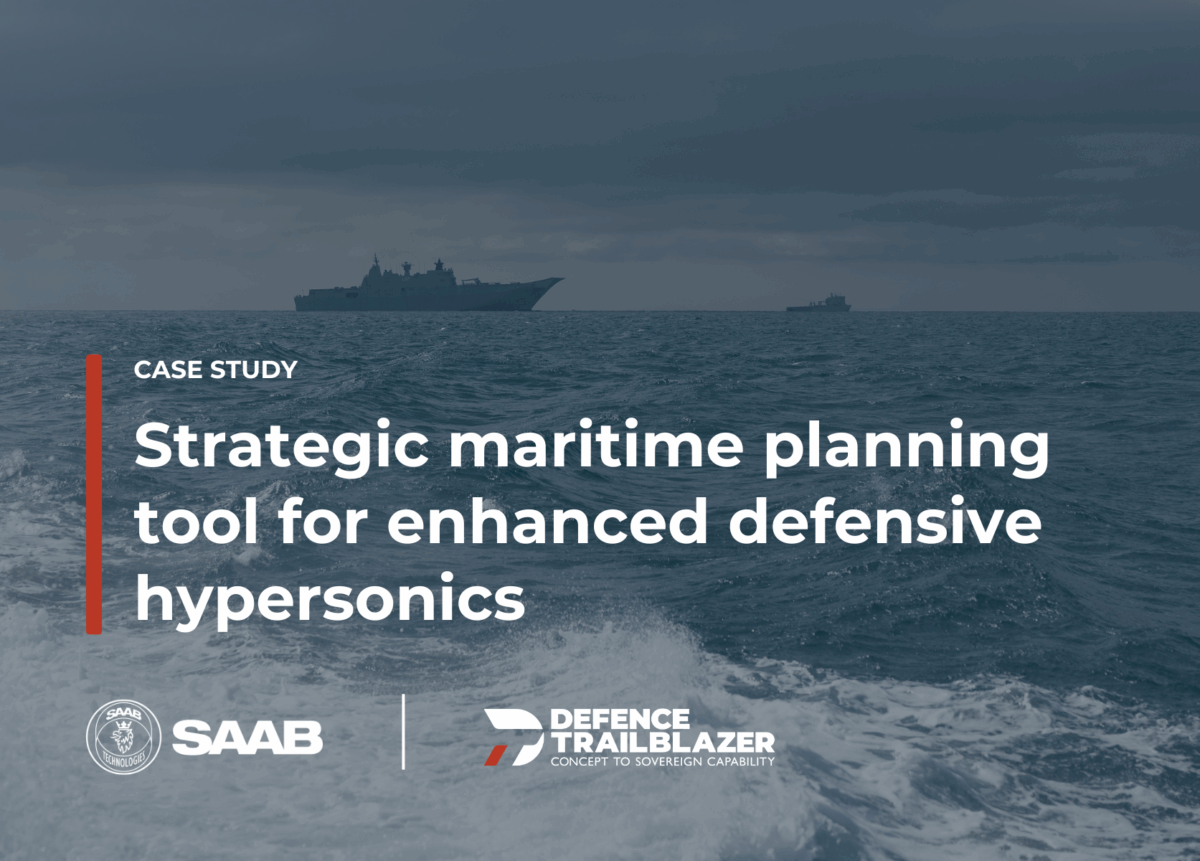
Main image: HMAS Canberra and HMAS Choules from RAN LHD Landing Craft during Exercise Talisman Sabre 2025. Photographer: LSIS Connor Morrison. Image credit: Royal Australian Navy.