Aurora Materials is accelerating the development of fluorescent markers to accurately identify and authenticate military supplies and capabilities, in collaboration with UNSW and the University of Adelaide. The project aims to deliver a prototype of Aurora Materials’ proprietary security tags and is funded by the Defence Trailblazer’s Accelerating Sovereign Industrial Capabilities (ASIC) program.
Counterfeiting is a significant threat towards national security, and military equipment such as replacement electronic components are particularly vulnerable. Aurora Materials is addressing this threat with a novel security solution that can rapidly identify and authenticate assets, protecting against counterfeiting.
The company has developed fluorescent markers made of tuneable emissive nanocomposites, using a method that makes them nearly impossible to reverse engineer. When illuminated with certain wavelengths of light, the materials emit a uniquely identifiable light-based fingerprint that is specific to each batch. This creates a non-replicable tagging capability to secure Defence supplies.
“The tags represent a unique solution to rapidly identify and authenticate valuable and mission assets in both combat Unmanned Aerial Systems and ‘zero trust’ supply chain domains,” said Dr Jason Holland, project investigator at Aurora Materials.
The project will be overseen by Aurora Materials, with research and technical support provided by university chief investigators Associate Professor John Arron Stride from UNSW and Dr Thomas Jacob de Prinse from the University of Adelaide.

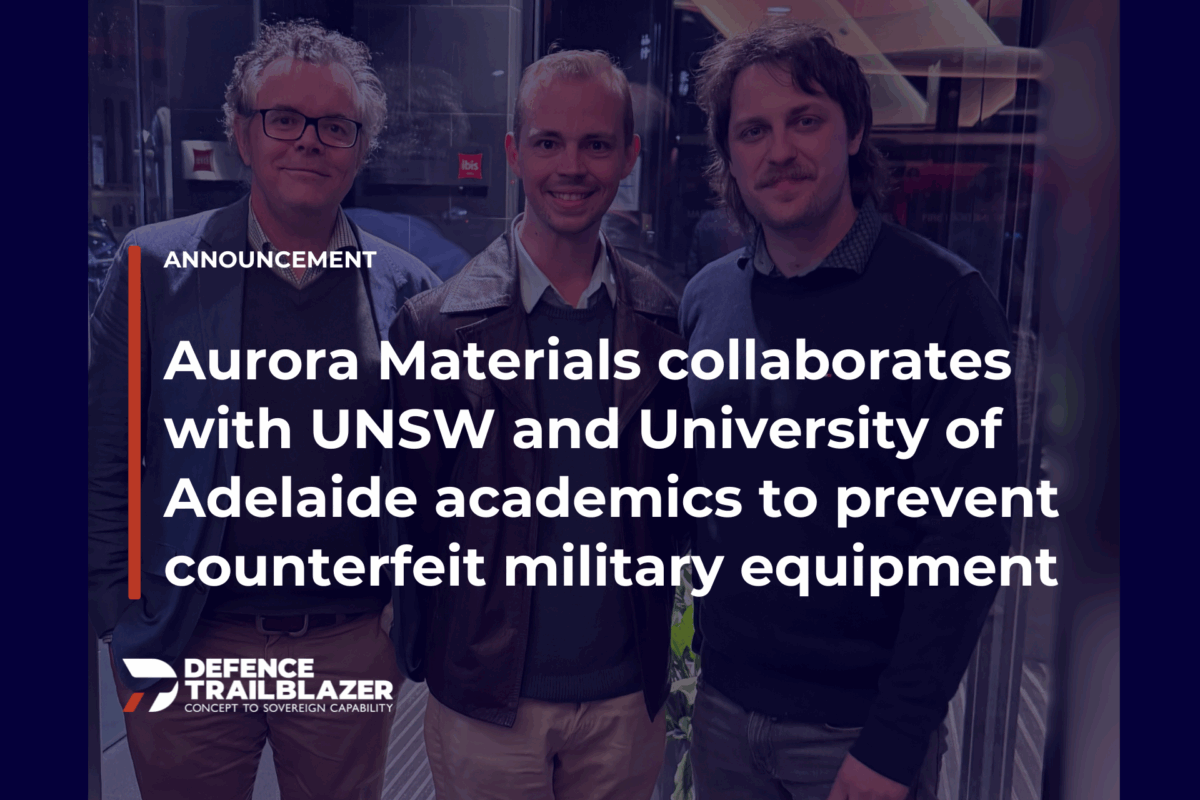
Pictured from left: Associate Professor John Arron Stride (UNSW), Dr Jason Holland (Aurora Materials), Dr Thomas de Prinse (University of Adelaide).
The project will demonstrate a scalable manufacturing process for the fluorescent markers using the solvothermal synthesis process at UNSW. This will be followed by photonics studies at the University of Adelaide that will be used to inform prototyping of a novel and handheld detector for in-field verification. The investigators will work with the Australian National Fabrication Facility OptoFab hub at the University of Adelaide on advanced coating solutions for textiles, metals, and plastics to make the tags suitable for different types of supplies.
Along with accelerating research commercialisation for the Australian Defence Force, the technology also provides multi-use cases for Australian manufacturing and materials sciences. “This project will establish a sovereign capability for scalable production in Australia, enhancing self-reliance in material production and critical chemical synthesis capabilities,” said Associate Professor Stride.
“It also builds important additional strength in the forward-looking area of strategic manufacturing of advanced materials and nanocomposites,” said Dr de Prinse.