Open-source intelligence leader Fivecast has demonstrated new capabilities for Fivecast ONYX, its AI-driven data collection and threat analytics solution for understanding and countering online influence. The AI integration has been advanced through a collaborative R&D project with Adelaide University researchers, supported by funding from Defence Trailblazer.
Information warfare can be propagated through high follower or high engagement social media accounts that expose huge audiences to inflammatory content. Fivecast ONYX captures interaction data that can identify connected entities and media activities, providing situational awareness and intelligence to aid with Defence and national security operations.
The research collaboration has enhanced the performance of Fivecast ONYX by integrating multi-agent artificial intelligence (AI) systems. The AI iteratively collects open-source intelligence (OSINT) and analyses interaction data to execute a research mission, such as investigating a disinformation campaign.
Fivecast’s Chief Data Scientist and project investigator Dr Jason Signolet said that the key R&D objectives were to expand the scale and efficiency of Fivecast ONYX as the company onboards more customers globally.
“Where previously analysts would be required to drive the tools, now the AI agent does the legwork while the analyst focuses on the outcome,” said Dr Signolet. “This provides a new way of interacting with Fivecast ONYX.”
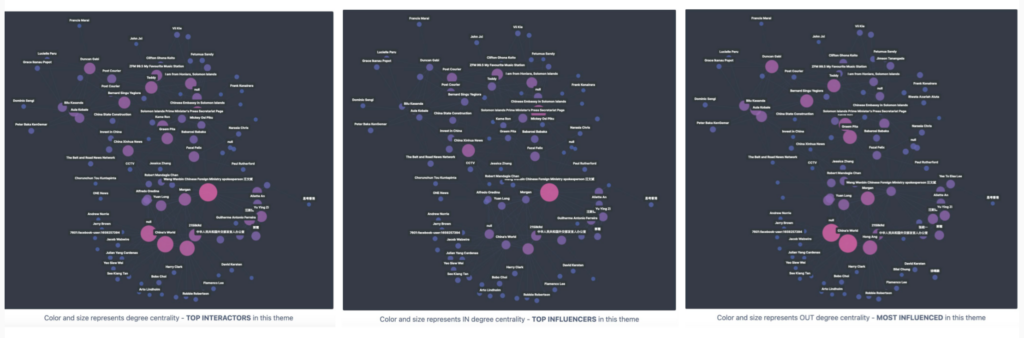
Heatmaps produced by Fivecast ONYX mapping interactions between social media actors (from left to right): top interactors, influencers and most influenced.
Adelaide University investigators Professor Lewis Mitchell and Dr Angus Lewis led experiments to drive down the iteration time of OSINT analyses.
“The challenge with automating processes with agentic AI is that many decisions get made behind the scenes, and issues can creep in as a result,” said Professor Mitchell.
“Here, we wanted to make this process more trustworthy. We used statistical data science methods in concert with AI, so that we could get the benefits of automation while maintaining trust in the results.”
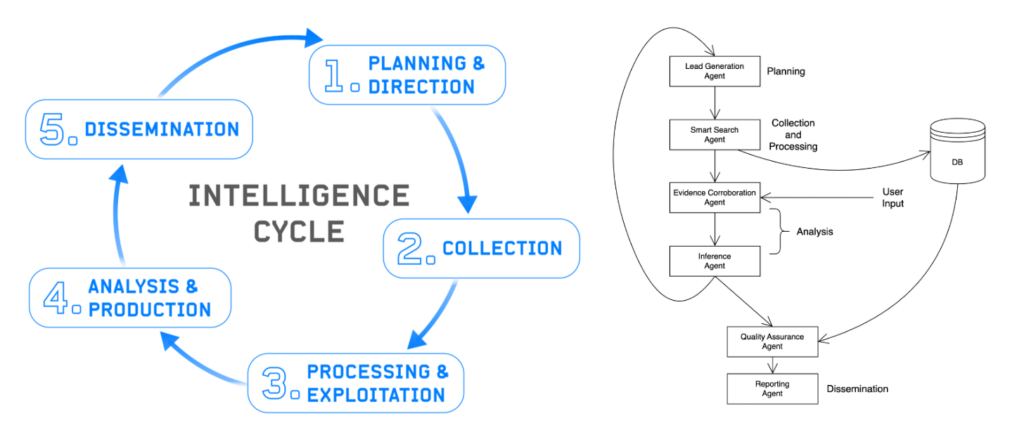
Left: The intelligence analysis cycle, which involves planning and executing a research plan, collecting OSINT, and iteratively collating and resolving. Right: The automated, iterative process taken by the multi-agent AI system.
Adelaide University student applies LLMs to map bias in social network interaction
The research highlights included work with Adelaide University MPhil student Yi (Max) Ren, who carried out an internship at Fivecast through Defence Trailblazer’s Industry Research Program.
Max worked closely with Fivecast to implement an approach to moral foundations detection within Fivecast ONYX based on Large Language Models (LLMs). This approach was motivated by how people in social networks interact with posts and interpret them differently based on their own opinions and viewpoints.
“The same post can have numerous ‘moral interpretations’, making it essential to model individual perspectives,” said Max. “The LLM approach produces a matrix that maps bias to provide analysts with interpretable information.”
The results have been published in ACL Anthology workshop proceedings, which coincided with the Association for Computational Linguistics (ACL) conference in 2026.
The collaboration has laid the groundwork for continuing R&D with Dr Lewis and potential opportunities for future PhD work.
“The tools and metrics developed in this project have a straightforward path to production for incorporating agentic AI in Fivecast’s OSINT solutions,” said Dr Signolet.
Dr Margaret Law, General Manager – Technology Development & Acceleration at Defence Trailblazer, said of the project, “It was exciting to see a demonstration of AI and Fivecast ONYX by our industry partners. This collaboration is a fantastic example of what is possible with direct, collaborative R&D between industry and universities.”