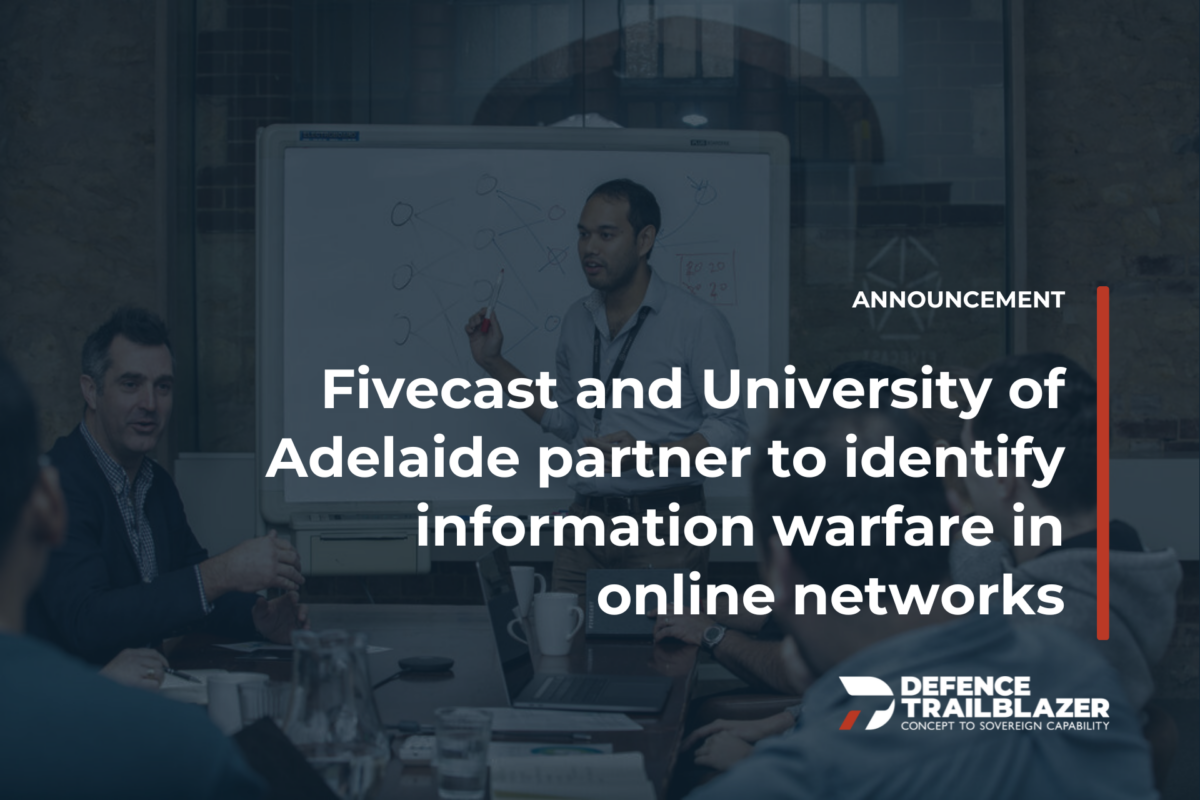
Defence Trailblazer is excited to announce that Adelaide-based company Fivecast, a global leader in open-source intelligence solutions, has signed a research project agreement with the University of Adelaide through the Technology Development & Acceleration (TDA) program. Through this collaborative research partnership, the project will advance Fivecast’s work on tracking how influence spreads within online social networks.
Fivecast’s project targets the grey zone activity of online influence, particularly as accelerated by technological advancements in AI. It will specifically focus on situations where inflammatory content could transition from being a low-risk, fringe interest to becoming more dangerous as a larger, more susceptible audience is exposed to the narrative.
Falling under the theme of Information Warfare, the project will provide Defence with a content analysis tool for situational awareness and intelligence for operations planning. Information Warfare is a critical component of Australia’s National Defence Strategy (NDS), aligned with its focus on strengthening national resilience, deterrence, and shaping the strategic environment.
Countering online intelligence is also directly linked with the AUKUS Pillar 2 Advanced Cyber capabilities – enhancements that are crucial for defending against cyber threats and supporting democratic resilience.
“We anticipate that these outcomes will help Defence to efficiently identify risks,” said Chief Data Scientist Dr Jason Signolet from Fivecast. “For example, in the context of overseas deployment of ADF personnel, we would aim to determine whether fringe anti-Australian online narratives were likely to stay on the fringe or move into the mainstream.”
The project will model the evolution of networks to distinguish the different processes that drive narratives, such as state-sponsored bots or trolls versus paid influencers, and between those who propagate misinformation unknowingly versus those who do so for personal gain.

AI has accelerated how influence spreads within online networks. Image: CCO.
“A key focus will be on identifying robust features that can withstand changes in tactics employed by influence operators, ensuring that our models remain effective as the landscape evolves,” said Dr Signolet.
The project is a collaborative effort between Fivecast and the University of Adelaide research team, led by Chief Investigator Professor Lewis Mitchell. “Our team will lead the network-analysis algorithm network, using a mix of content-based and graph theoretical metrics to measure influence,” said Professor Mitchell.
These research findings will be synthesised into a prototype software application featuring a dashboard for alerting users to detected risks and anomalies, leveraging data in near real-time.
For more information, visit the Fivecast website.