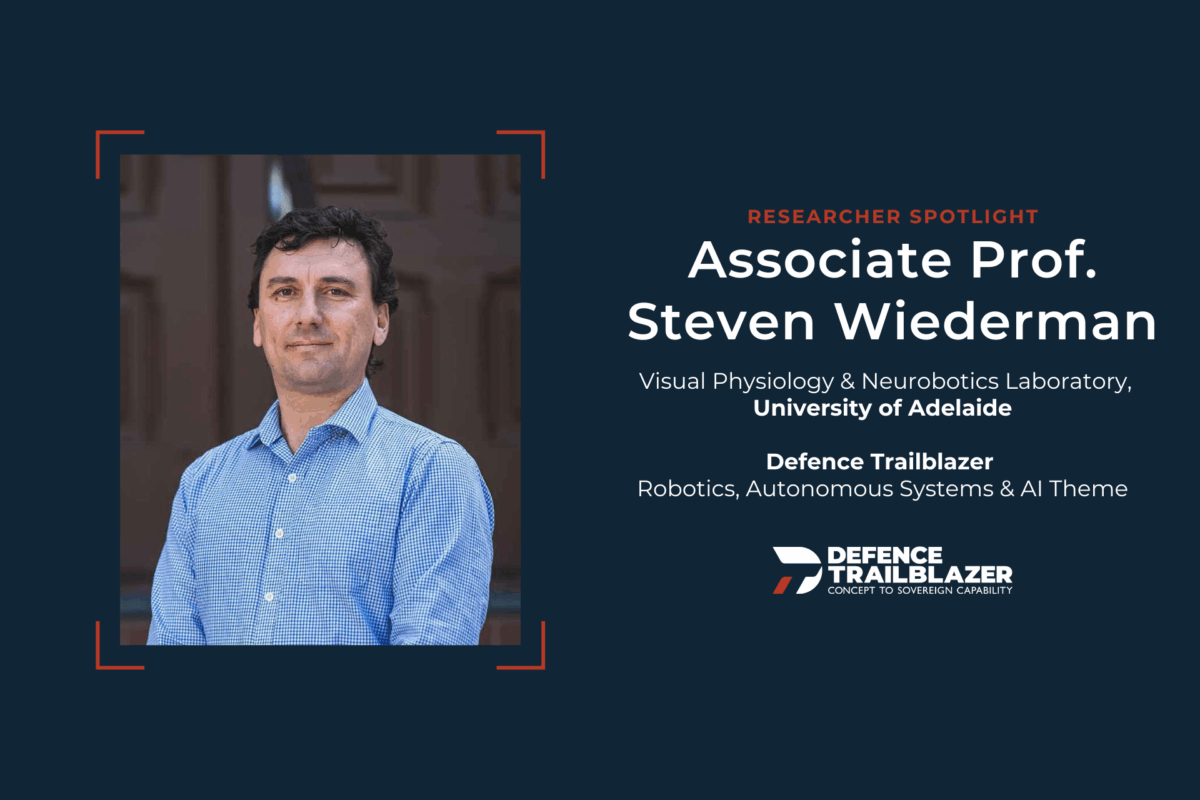
Associate Professor Steven Wiederman
Visual Physiology & Neurobotics Laboratory, School of Biomedicine , University of Adelaide
Defence Trailblazer Robotics & Autonomous Systems Theme
Steven Wiederman is an interdisciplinary researcher working across the fields of sensory neuroscience, computational neuroscience and autonomous systems.
As the head of the Visual Physiology and Neurobotics (VPN) Laboratory, he leads research that uses flying insects as animal models for how the brain processes visual information.
“We run a very integrated lab where we investigate visual processing from behavioural, physiological, anatomical and computational perspectives,” said Associate Professor Wiederman.
“Our laboratory is very much a wet neurosciences lab, which means that we conduct biological experiments From these anatomical and physiological insights, we derive computational models and then we translate these models to hardware, for autonomous systems in defence and other applications.”
the dragonfly animal model
“Dragonflies are a great animal model for visual physiology. Their brain is not much bigger than a grain of rice and uses a couple of million neurons, compared to the human brain which has approximately 86 billion neurons.
Unlike other insects, dragonflies don’t really use other modalities apart from their vision to detect small moving targets. They can detect a tiny target in a very cluttered background, with close to a 90 plus percent success capture rate – making them an apex predator in the insect world.
For our researchers, a typical day involves going down to the park to catch dragonflies. Back in the laboratory, we insert electrodes into their brain and record information from individual neurons of interest. Some of these neurons detect moving targets, even in a swarm, and predict the target’s future location.
We develop an animal model system that encapsulates and predicts target detection in a cluttered environment. By carefully controlling the visual stimulus and monitoring the response of the neurons, we can develop computational models. Then we can test these models to see where they work and where they fail.
Our lab has collaborated with industry to put our models into hardware on drones and unmanned ground vehicles. With Defence Trailblazer industry partner, Adelaide-based company Acacia Systems, we’ve developed a FPGA (Field Programmable Gate Array) device. This real-time programmable hardware is used for the detection of moving objects in the background.”
why defence?
“Over my entire research career, I have worked within defence collaborations. When I was carrying out my PhD research in insect physiology, my University of Adelaide supervisor had defence contracts and my external supervisor worked in the US defence industry. I was able to travel to the US several times, thanks to the ‘Windows on Science’ program to meet with scientists in the Air Force Research Laboratory.
Since I established my laboratory, I have been involved with three defence projects working with industry and academic collaborators: the Counter Improvised Threats Grand Challenge, the Future Submarines project, and our current established relationship with Acacia Systems.”
Research capabilities at the University of Adelaide
“We are one of a number of laboratories around the world that are inspired by insect vision and translating that into engineering outcomes.
Defence has always been very interested in the application of our research and development, and in the research aspects of the novel algorithms.
Having demonstrated our work through Australian Research Council projects, it was a natural progression to establish a Defence Trailblazer project to continue research into developing bio-inspired algorithms for hardware detection, particularly with our long-standing collaboration with Acacia Systems.”
The Defence Trailblazer approach
“In our research, there’s always more questions to address. We’ve developed some very interesting algorithms for target detection and moving features, but none of it would work without very strong stabilisation algorithms.
The Defence Trailblazer project has provided a great opportunity to explore bio-stabilisation. We’re working on testing with our camera systems and hardware devices, and we’re also elaborating models developed over many years.
Our industry partners have their own commercial pathways for target detection, but we’ve been able to test bio-inspired algorithms with lower Technology Readiness Levels (TRLs). We’ve been able to balance both aspects – looking to our biological systems for insights and feeding those into higher TRL solutions or vice versa.
This has been a valuable opportunity to provide my insights directly into the project.”
Background
Associate Professor Wiederman began his research career at the University of Adelaide and established the VPN Laboratory in January 2014, following several years of postdoctoral support from the US Air Force Office of Scientific Research and the Australian Research Council (ARC). He was awarded an ARC Discovery Early Career Researcher Award in 2015, allowing him to build a team of scientists and engineers.
He received an ARC Future Fellowship in 2019 to support ongoing investigation of visual processing. Associate Professor Wiederman continues to receive ARC support for his work with interdisciplinary and international colleagues on two ARC Discovery Projects.
During this period, he has been an investigator on several industry-government research contracts, including working with industry on the Counter Improvised Threats Grand Challenge, followed by a partnership with Acacia Systems on a Future Submarines project. During this time, he also worked on a DSTG sponsored Human Factors project with interdisciplinary colleagues.
Associate Professor Wiederman is also Associate Dean Research at the Faculty of Health and Medical Sciences at the University of Adelaide.