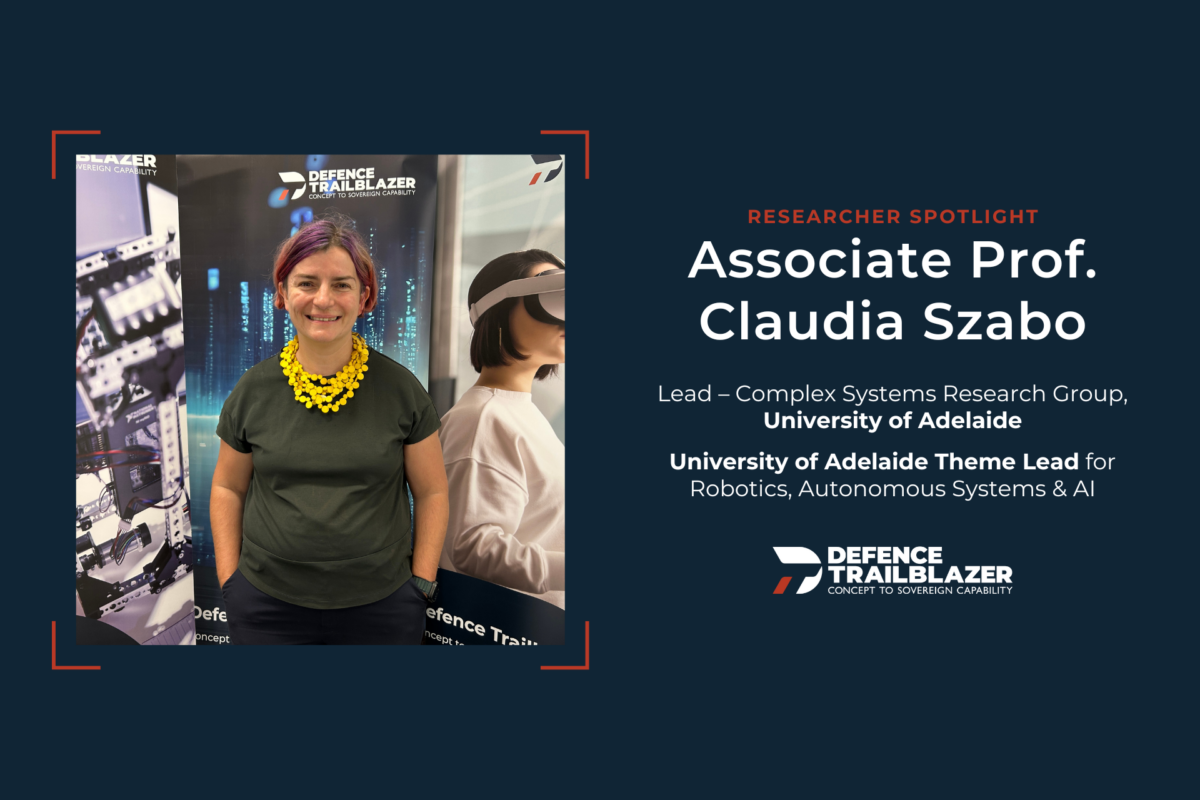
Associate Professor Claudia Szabo
Lead – Complex Systems Research Group, University of Adelaide
University of Adelaide Theme Lead for Robotics, Autonomous Systems & AI (RASAI)
Defence Trailblazer is committed to driving university-industry collaborations, and our academic R&D Theme Leads are at the forefront of facilitating these partnerships.
Associate Professor Claudia Szabo leads the Defence Trailblazer’s University of Adelaide team for Robotics, Autonomous Systems and Artificial Intelligence (RASAI), one of five key areas aligned with the Defence Strategic Review.
“Our researchers excel in both deeply theoretical and very applied AI research,” said Associate Professor Szabo. “My role is to connect industry with academia by growing research projects and partnerships.”
Studying complex systems in tough environments
“My research focus is on modelling and analysis of complex systems, which encompass many systems with interactive components.
One of the key aspects of my work is understanding resilience and robustness of systems in general, and then complex systems in particular. If you have systems that are resilient, you can do a better job at reacting to events that are unforeseen.
In terms of complex systems behaviour, understanding behaviour and the prediction of an adversary’s behaviour will also allow us to make better decisions quicker and better. Firstly, with deeper situational understanding, but also a deeper understanding of the effects of the decisions that we’re making.
I do research in autonomous decision-making for complex systems that operate in really tough environments, where a lot of things can go wrong. This might include cyber-attacks, or when entities are partitioned from each other in combat. In these environments, decisions have immediate, critical impact.”
Why Defence research?
“I find Defence projects exciting because they offer an excellent opportunity to apply the more theoretical aspects of my research work.
My work fits very well within the autonomous decision-making sector of Defence. In Defence, autonomous decision making is critical, as well understanding the rationale behind decisions, and the performance bounds.
The work that I do provides us with an asymmetrical advantage, because the decision making algorithms that we are studying and developing are built to react very quickly to dynamic environments and to consider heterogeneity both in our adversary responses and in our actions.”
RASAI capabilities
“At RASAI, we’re looking at robotics, autonomous systems and artificial intelligence. A lot of the decision-making algorithms tend to be focused on artificial intelligence: whether that’s machine learning, or the application of various heuristics to predict and understand outcomes or pathways.
We have a brilliant pool of researchers at the University of Adelaide, with a spectrum of both theoretical and applied researchers within the RASAI theme.
We usually start with problem that industry wants to solve. That’s where I come in as Theme Lead. I facilitate and help to define the problem in ways that can be solved through academic research.
With this really deep level of expertise, I think the possibilities of applying this knowledge to industry problems is endless.”
The Defence Trailblazer approach
“Defence Trailblazer presents an excellent opportunity to connect academics with industry.
It shows just how much potential there is within academia, and how much interest there is from industry to invest in and advance this work. To me, it’s very exciting and positive. There is deep research excellence within the University of Adelaide and keen industry partners, so the opportunities are super positive and very promising.
One of the most rewarding aspects is seeing projects start from the inception of an idea, a connection between a partner and an academic, and then seeing them grow into proposals and fully-fledged projects.
Seeing people working on projects, and the specific outcomes coming out of them – that’s really rewarding for me. It’s like you’re growing a plant, but it grows in three months rather than two years.”
Investing in the defence industry workforce
“The Defence Trailblazer programs are amazing opportunity for students, especially for those students who are interested in applied research and fostering industry partnerships.
I currently supervise one PhD student and one Master’s student through the Defence Trailblazer Industry Research Program. They are both looking at autonomous decision making, one through the domain of counter UAS and the other in cyber security.
On the industry side, I think it’s an absolute amazing opportunity for the sector. With a very small investment, they can gain back a deeply skilled workforce. Students that come out of the Defence Trailblazer program tend to have really hands-on experience, so there’s a very clear pipeline.”
Background
Associate Professor Szabo has worked extensively with Defence partners in areas of autonomous decision making and specific hybrid algorithms, and the verification and validation of desired outcomes and behaviours.
At the Complex Systems Research Group at the University of Adelaide, she leads research into complex adaptive systems – in particular, systems that operate in contested and dynamic environments.
Associate Professor Szabo has received numerous awards for outstanding teaching and research excellence, including the Faculty of Engineering, Computer and Mathematical Sciences Learning and Teaching Award (2021) and the Vice-Chancellor’s Women in Research Excellence Award (2018). She is the Co-Editor-in-Chief of the Journal of Simulation.