Lockheed Martin Australia is making an impact in systems-level R&D architecture through six R&D projects supported by the Defence Trailblazer. In collaboration with UNSW and Adelaide University researchers and delivered through Lockheed Martin Australia’s Advanced Systems & Technologies R&D team, the projects are building advanced capabilities in hypersonics, space systems and artificial intelligence (AI) to inform their ‘Southern Shield’ anti-access, area-denial R&D strategy.
Advanced Systems & Technologies (AST) is Lockheed Martin’s first and most advanced multidisciplinary R&D facility located outside the United States. AST has established a coordinated, national R&D effort designed to rapidly demonstrate and de-risk advanced capabilities addressing Australia’s defence needs as set out in Defence’s National Defence Strategy.
Southern Shield provides the mission-driven framework for coordinating R&D partnerships that allow advanced technologies to be rapidly integrated, demonstrated and evaluated at a system level.
“The Southern Shield R&D strategy is designed to provide a core innovation system that can be applied to multiple programs required to achieve the vision of Australia’s Future Integrated Force,” said Dr Tony Lindsay, Director of AST at Lockheed Martin Australia.
Path to Capability
Six projects demonstrate Lockheed Martin Australia’s commitment to stewardship for major operational capabilities through the execution of a coordinated, national R&D effort. The program is designed to rapidly deliver new sovereign technologies for Defence hypersonics, counter-hypersonics, and space-related capabilities.
The R&D collaboration further strengthens the strategic partnership between Lockheed Martin Australia and Defence Trailblazer. Lockheed Martin Australia played a key role in the co-development of Defence Trailblazer’s Combat Systems Engineering Micro-credentials, delivered by Adelaide University and UNSW.
Dr Sanjay Mazumdar, Executive Director at Defence Trailblazer, said of the partnership: “Lockheed Martin Australia has demonstrated ongoing dedication to Defence Trailblazer’s R&D and workforce portfolios, investing in Australian technologies and supporting the development of a future defence-ready workforce.
“This suite of collaborative projects will bring momentum for advanced hypersonics and space sensing technologies to Defence through an integrated systems approach. We are proud to support Lockheed Martin Australia in delivering advanced, transformative operational capabilities across all domains.”
Hypersonic vehicle analysis and flight testbed projects
Three of the projects are aligned with the strategic Defence priority of Hypersonics & Counter-Advanced Threats, by enhancing critical sovereign capabilities for vehicle design and machine learning capabilities.
The projects are led by Professor Andrew Neely, chief investigator and Defence Trailblazer’s UNSW Theme Lead for Defensive Hypersonics & Counter-measures, and Dr Scott Beinke, partner investigator at Lockheed Martin Australia.
The ‘sovereign rapid aerodynamic design tools’ project investigated and developed methods for rapidly predicting the aerodynamic performance of hypersonic vehicle geometries using analytical, empirical, and computational methods.
The ‘aerothermal shape distortion of hypersonic vehicles’ project extends existing collaborative research to model how aerothermal heating distorts the shape of hypersonic vehicles and investigates the impact of these effects on the performance and controllability of hypersonic systems.
“By developing these methods for predicting the performance of hypersonic systems, the projects are providing tools and insights to improve early performance analysis and later detailed design of future hypersonic vehicles,” said Dr Beinke.
The analysis methods and R&D from these projects are being applied to the design of a flight system in the ‘Common Front End (CFE) hypersonic flight testbed’ project.
The overall goal of the CFE project is to develop a high-speed flight testbed capability that can accommodate multiple experiments to enable greater access to flight testing opportunities.
“This increased access is needed to accelerate the pace of hypersonic and countermeasures technology development for the benefit of both established and emerging defence industry players and therefore for Defence,” said Professor Neely.
“UNSW Canberra has a strong relationship with Lockheed Martin Australia, and we welcome the opportunity to continue to work collaboratively to develop and test these systems, leveraging our world-class hypersonic capabilities and facilities.”
Extreme AI for Space Missions and Space Domain Awareness on the Edge
As one aspect of the Southern Shield anti-access/anti-denial (A2/AD) technology development, Lockheed Martin Australia is developing and integrating sovereign advanced sensing and associated automated information workflows in the context of space-based hypersonic vehicle detection and tracking through two projects led by Professor Tat Jun (TJ) Chin, Defence Trailblazer’s Defence Space Technologies Theme at Adelaide University.
‘Space Domain Awareness on the Edge’ will harness machine learning to improve the performance of optical sensors to monitor the night sky. A further objective is to raise the computational efficiency of the data processing for deployment on edge compute devices, as on-satellite space surveillance provides a complement to ground-based systems.
Space Layer Optimisation
To support Integrated Air and Missile Defence, the ‘Space Layer Optimisation’ project is increasing sovereign capability to rapidly design and assess satellite constellations, for the purposes of demonstrating the dynamic utilisation of space-based assets as part of the integrated, all-domain system.
The project is led by Associate Professor Melrose Brown, Director for UNSW Canberra Space and Defence Trailblazer’s UNSW Defence Space Technologies Theme Lead, and Luke Tracey, project lead at Lockheed Martin Australia.
The project investigators are developing the methodology and software tools for design and performance assessments of satellite constellations, with the goal of optimising for integration with other all-domain tools required for end-to-end capability assessment.
The outcomes are aligned with Defence’s priority to invest in capabilities that strengthen space-based situational awareness and decision advantage, as outlined in the 2026 National Defence Strategy.
“Ultimately, this will inform studies in the design and improvement of a Future Integrated Force A2/AD capability,” said Dr Lindsay.
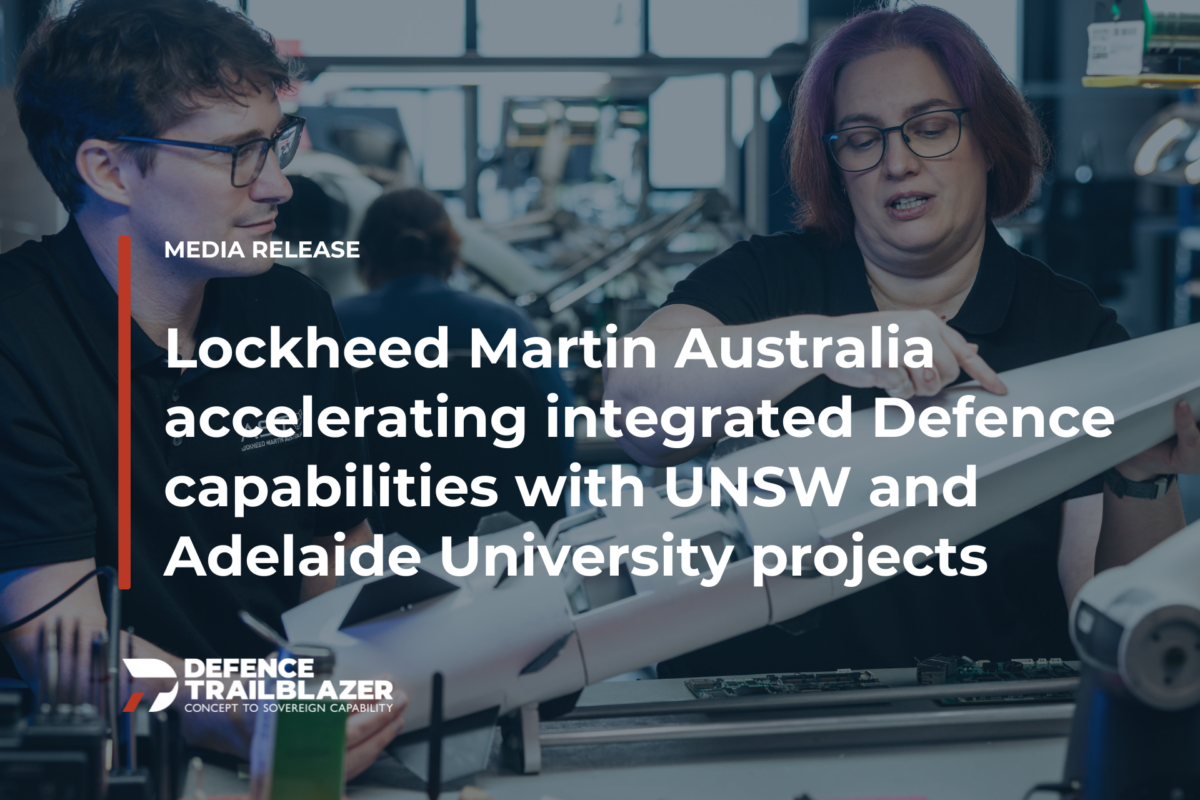
Main image shows the Advanced Systems & Technologies R&D team at Lockheed Martin Australia.
About Lockheed Martin Australia: Headquartered in Canberra, Lockheed Martin Australia is a wholly-owned subsidiary of Lockheed Martin Corporation. The company employs more than 1,800 people in Australia working on a wide range of major programs spanning all Defence warfighting domains, national security and civil sectors.
Contact Information: For media inquiries, please contact: Joanne Hon, Head of Communications Australia & New Zealand, Lockheed Martin, joanne.hon@lmco.com, 0458 175 404
About the Defence Trailblazer: Defence Trailblazer is a collaborative partnership between Adelaide University and UNSW supported by the Department of Education and over 200 industry partners and associates. Defence Trailblazer is dedicated to advancing Australia’s defence capabilities through innovative research and strategic partnerships. By collaborating with industry, academia, and Defence (particularly DSTG, VCDF Group, CASG and the Service Innovation Units), we aim to develop and commercialise breakthrough technologies that address critical national security challenges.
Contact Information: For media inquiries, please contact: Ilsa Stuart, Senior Partnerships Manager, 0402 260 771 istuart@dtb.solutions