Our Staff Mobility Program strengthened Australia’s defence innovation system by connecting university capability with industry partners, promoting knowledge transfer and fostering a dynamic exchange of expertise.
The program generated strong industry interest in accessing university expertise and working with researchers to lift industry capability and accelerate technology and product commercialisation. It has strengthened university–industry linkages, creating repeatable pathways for applied research and commercialisation.
Participation in the Staff Mobillity Program also improved academics’ understanding of industry requirements and operational environments, commercial priorities and applied research settings, increasing relevance of research. This has helped to build capability in industry engagement, commercialisation and translational research practice, while creating further opportunities for collaborative research activities.
The program has also highlighted practical institutional improvements, particularly in relation to intellectual property, contracts and secondment arrangements. These improvements are important for reducing friction, supporting participation and enabling more effective university-industry collaboration.
Program achievements at-a-glance
- 14 academics activated into SMP placements with eight industry partners
- Transfer of knowledge and expertise between Adelaide University, UNSW and participating industry partners
- New opportunities for research translation and broadening academics’ experience
- Access to university facilities for industry R&D learnings for streamlining industry-university secondments
Challenges
Defence Trailblazer addressed common collaboration challenges by employing a dedicated Partnerships Manager who had a deep understanding of the capabilities available across both Adelaide University and UNSW. This role played a pivotal part in simplifying engagement for industry partners, helping them clearly identify and access the expertise most relevant to their needs.
By working closely with partners from the point of initial enquiry, the Trailblazer team was able to efficiently connect them with suitable academics, significantly reducing barriers to collaboration and enabling more targeted, productive partnerships. This coordinated approach also helped build confidence among both industry and academic participants, supporting stronger engagement in longer-term mobility activities.
What we’ve learned
Creating lasting impact means building on what works. Our experience highlights four key enablers that help collaboration thrive:
- Make collaboration part of the core job
When working with industry is built into how academic success is recognised and rewarded, it becomes business-as-usual. Embedding mobility into workload, performance and career progression helps turn great collaboration into standard practice, driving stronger outcomes for both research and industry. - Back it with the right support
Collaboration works best when it’s easy to navigate. Dedicated partnership and coordination roles help connect the dots, matching the right expertise to the right challenge, streamlining processes, and supporting participants every step of the way. - Shine a light on the opportunity
Visibility drives momentum. Promoting mobility opportunities across both industry and universities helps people quickly see what’s possible – and where they can contribute. The result is more connections, better fit, and faster pathways to impact. - Build for the long term
Sustainable funding keeps great programs moving. Blended models, including industry co-investment, help turn early success into lasting capability. This ensures mobility continues to deliver value well into the future.
Case study – University academic seconded to SRC Aus:
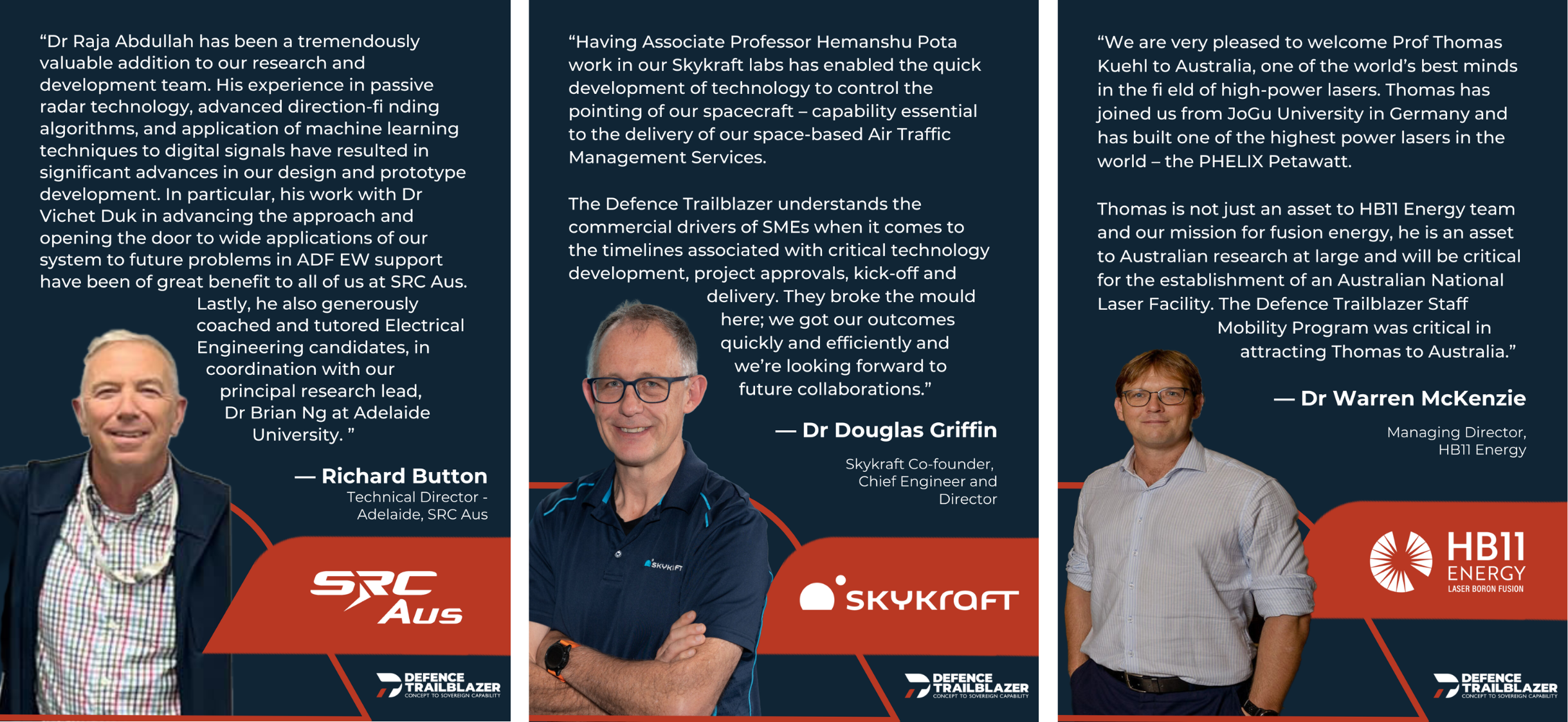
SRC Aus works closely with the Australian Government to solve crucial Electronic Warfare (EW) challenges. To provide senior level expertise and support to an SRC Aus project developing next-generation EW capability, SRC Aus participated in Defence Trailblazer’s Staff Mobility Program, enabling Adelaide University Research Fellow Dr Raja Abdullah from the School of Electrical and Mechanical Engineering to take part in a university secondment that has embedded him at SRC Aus for 22 months.
“Participating in the Staff Mobility Program with SRC Aus has been a transformative experience for me,” said Dr Abdullah. “Working alongside the SRC Aus experts and experienced engineers in their cutting-edge facilities has significantly enhanced my expertise in developing electronic systems that meet rigorous military standards.
“This powerful partnership between industry and academia produces critical defence outcomes and has laid a strong foundation for my future contributions in this field.”
The partnership showcased how Defence Trailblazer’s programs are integrating defence industry and academia to unprecedented levels. “Dr Abdullah has been a tremendously valuable addition to our research and development team. His experience [has] resulted in significant advances in our design and prototype development. His work in advancing the approach and opening the door to wide applications of our systems to future problems have been of great value to all of us at SRC Aus,” said SRC Aus Technical Director Richard Button.