SmartSat CRC has launched its E-SPARC (Event-based Sensing Payload for Autonomous Rendezvous Control) project, supported by funding from Defence Trailblazer. The project is an international collaboration between SmartSat CRC, the AI for Space Group at the University of Adelaide, Infinity Avionics and Blackswan Space.
The project will launch an event-based sensing payload and utilise it on a rendezvous and proximity operations (RPO) demonstration space mission with an international partner.
E-SPARC enables high-precision RPO and could enhance local space domain awareness (SDA), particularly in scenarios where traditional sensing approaches are limited by lighting, dynamics or proximity constraints. Leveraging artificial intelligence in the event sensor and onboard acceleration hardware, the system performs real-time perception capabilities that can enable detection, tracking and pose estimation of nearby objects autonomously.
The spacecraft perception algorithms that will shape the mission have been developed by the AI for Space Group, led by SmartSat CRC Professorial Chair Tat-Jun Chin, Defence Trailblazer Theme Lead for Defence Space Technologies at the University of Adelaide.
“The usage of event sensing, which has a very high dynamic range and data rate, enables E-SPARC to operate in real-time and under the harsh and inconsistent lighting conditions of space,” said Professor Chin.
The payload is being integrated at the SmartSat Scarlet Lab and will be tested at the University of Adelaide’s Extraterrestrial Environmental Simulation (EXTERRES) Analogue Facility. It will also undergo testing and validation at the GNC Rendezvous, Approach and Landing Simulator testbed at European Space Agency’s ESTEC technical centre in the Netherlands.
By advancing this technology from lab to orbit, the project strengthens Australia’s sovereign space capability, contributes to Defence-aligned SDA and space control priorities, and opens pathways for future applications in civil and commercial space servicing.
“E-SPARC is a fantastic project that combines and matures technologies from our portfolio and partners to develop an innovative payload for future space capabilities. It is a great team and another SmartSat project that’s destined for space through Scarlet Lab,” said Dr Carl Seubert, Chief Research Officer at SmartSat CRC and project co-lead.
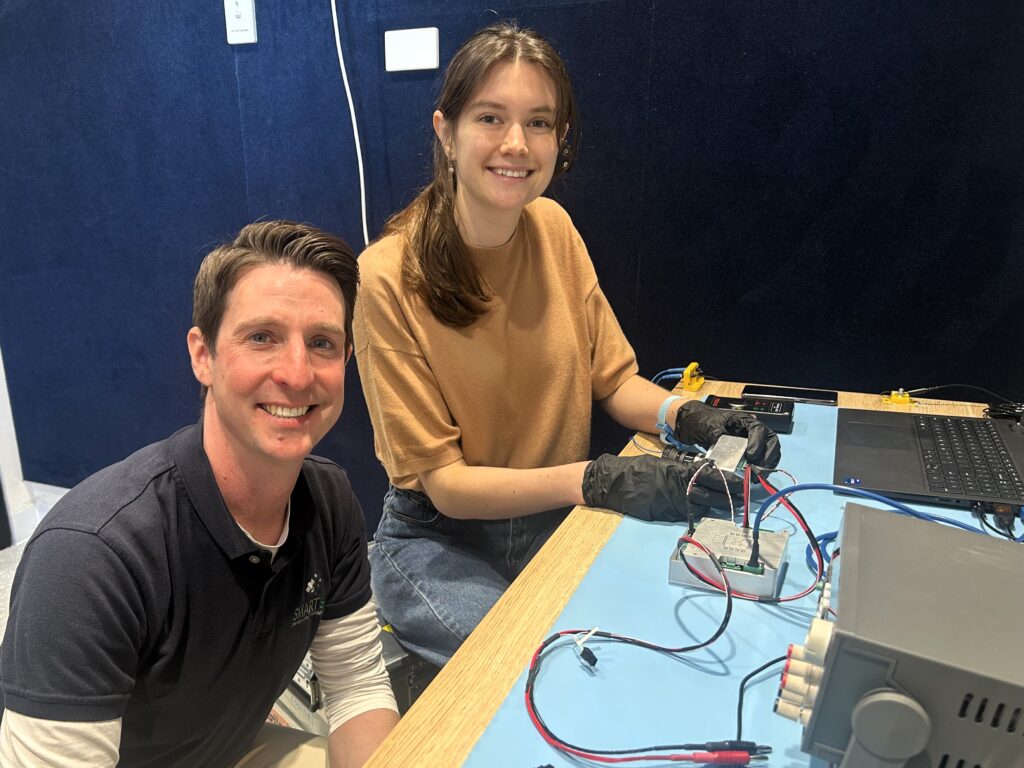
Satellite Systems Engineer Nick Manser (SmartSat CRC) and University of Adelaide researcher Sofia McLeod, pictured in the Scarlet Lab.
About SmartSat CRC: The SmartSat CRC is a consortium of universities and other research organisations, partnered with industry that has been funded by the Australian Government to develop know-how and technologies in advanced telecommunications and IoT connectivity, intelligent satellite systems and Earth observation next generation data services.
Contact Information: For media inquiries, please contact Madison White, Marketing & Communications Coordinator, 0402 245 039 madison.white@smartsatcrc.com