Australian cybersecurity firm Bluerydge has successfully demonstrated its sovereign artificial intelligence chatbot in a collaborative project with UNSW Canberra, supported by funding from Defence Trailblazer.
Designed for use in secure and disconnected environments, SierraBlue is a custom large language model (LLM) purpose-built to support Defence and other sensitive sectors with mission-ready AI capability.
Trailblazer-Funded Acceleration of Sovereign Capability
The SierraBlue project is led by Bluerydge innovators Adam Haskard and Tom Kazan (both Co-Founders and Directors at the company), in close partnership with researchers at UNSW Canberra.
Co-funded by Bluerydge and Defence Trailblazer’s Accelerating Sovereign Industrial Capabilities (ASIC) program and delivered over seven months, SierraBlue reflects Defence Trailblazer’s goal to fast-track the translation of high-potential research into operational technologies.
“The Defence Trailblazer program is critical because it bridges the gap between leading-edge research and deployable Defence capability,” said Haskard. “For Bluerydge, and for our partners in secure robotics, this program enables us to take initiatives like SierraBlue beyond the academic domain and into embodied AI systems that directly enhance Defence readiness.”
“Defence Trailblazer allowed us to move quickly from advanced research to a working capability,” said Dr Timothy Lynar, academic lead at UNSW Canberra. “It’s a strong example of how academic and industry collaboration can deliver impact where it’s needed most. The program has been a great pathway to get to minimum viable product quickly and to utilise the resources of the university sector.”
Technology Designed for Secure, Sensitive Environments
SierraBlue is designed to meet the growing need for sovereign, high-assurance AI in sectors such as Defence, government, finance and healthcare. With support for encrypted data streams and configurable access controls, it offers organisations a trusted AI solution that can be adapted to a wide range of specialist workflows.
The LLM has been trained on bespoke data sources such as intelligence reports, logs and raw databases. It has been engineered for deployment in environments where cloud-based AI is unsuitable or restricted. Product demonstrations showed its capability across a range of operating conditions including mobile tactical deployments and secure data centre infrastructure.
“This milestone is a major validation of the innovation and collaboration behind SierraBlue,” said Haskard. “It demonstrates that sovereign AI can be both operationally effective and secure in the most sensitive contexts.”
Embedding into Cyber-Physical Systems
With product testing and validation completed, SierraBlue now moves into its next phase of development. The focus is on embedding the LLM into cyber-physical systems, including autonomous vehicles, unmanned platforms, secure robotics and human–machine teaming applications.
“SierraBlue is already demonstrating its value in secure environments,” said Kazan. “Its potential for integration across Defence, Intelligence and other critical sectors opens the door to a new generation of AI enablement.”
These domains are rapidly becoming central to Defence capability and national resilience, as forces seek autonomous systems that can reason and respond in real time without external connectivity.
“Embodied AI is central to the future of Defence capability,” said Haskard. “By embedding SierraBlue into robotic and autonomous systems, we’re enabling platforms that can reason, learn and act independently in complex, contested environments without relying on external connectivity.”
As the team begins to host product demonstrations with Defence and industry, SierraBlue is well-positioned to support Australia’s Defence priorities.
“SierraBlue is a clear example of what Australia can achieve when we invest in sovereign capability,” said Kazan. “By keeping critical AI expertise and infrastructure here at home, we ensure Defence and Government can rely on solutions that are trusted, resilient, and mission-ready.”
For more information, visit the Defence Trailblazer website and Bluerydge website.
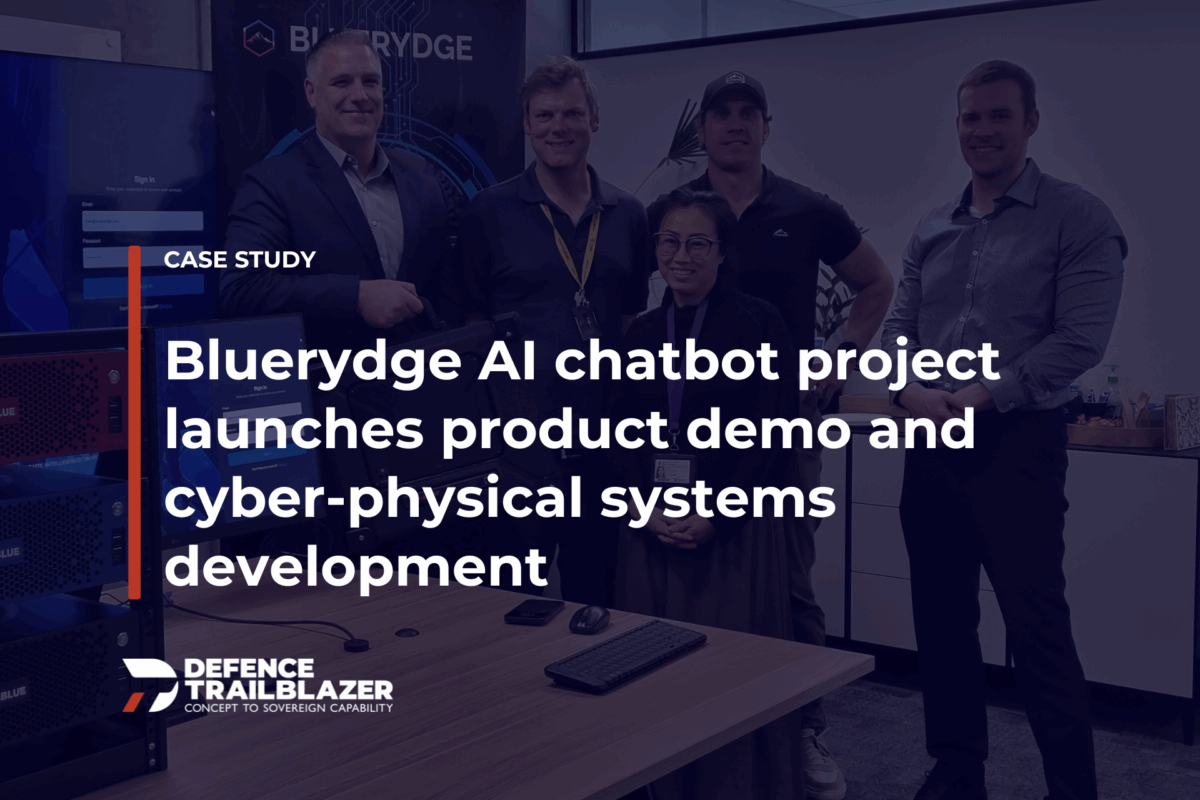
Pictured in main image back row, from left: Jim Boekel (Bluerydge Director and CEO), Dr Tim Lynar (UNSW Canberra), Adam Haskard and Thomas Kazan (Bluerydge Directors). Front row: Dr Lisa Liu (postdoctoral research fellow, UNSW Canberra).
Investigator Profile: Dr Timothy Lynar
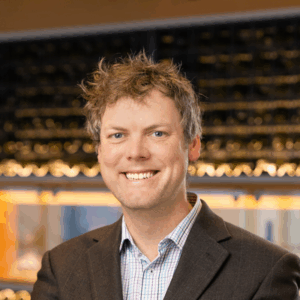 Senior Lecturer, School of Systems & Computing & Lab Lead, Innovation Lab for Cyber Security and Machine Learning, UNSW Canberra
Dr Lynar is a researcher and practitioner with a specialised focus in cyber security, Internet-of-Things, modelling, resource allocation, simulation, and high-performance distributed computing, combined with experience in networking, and systems administration. He has a diverse breadth of industry experience, including over seven years as a researcher and Master Inventor at IBM.
Dr Lynar’s research is highly relevant to Defence challenges, and he has been awarded numerous research grants to work on project with Defence Science Technology Group. He has conducted research into cyber assurance in energy systems, modelling for military wargaming, building resilience to internal cyber disruption, and algorithms for decision-making in contested environments.
He is the founder of the spin-out company Epicentre, which uses epidemiologically inspired methods for malware detection and risk quantification, and he was part of Defence Trailblazer’s Entrepreneurial Foundations for Defence 2024 cohort.