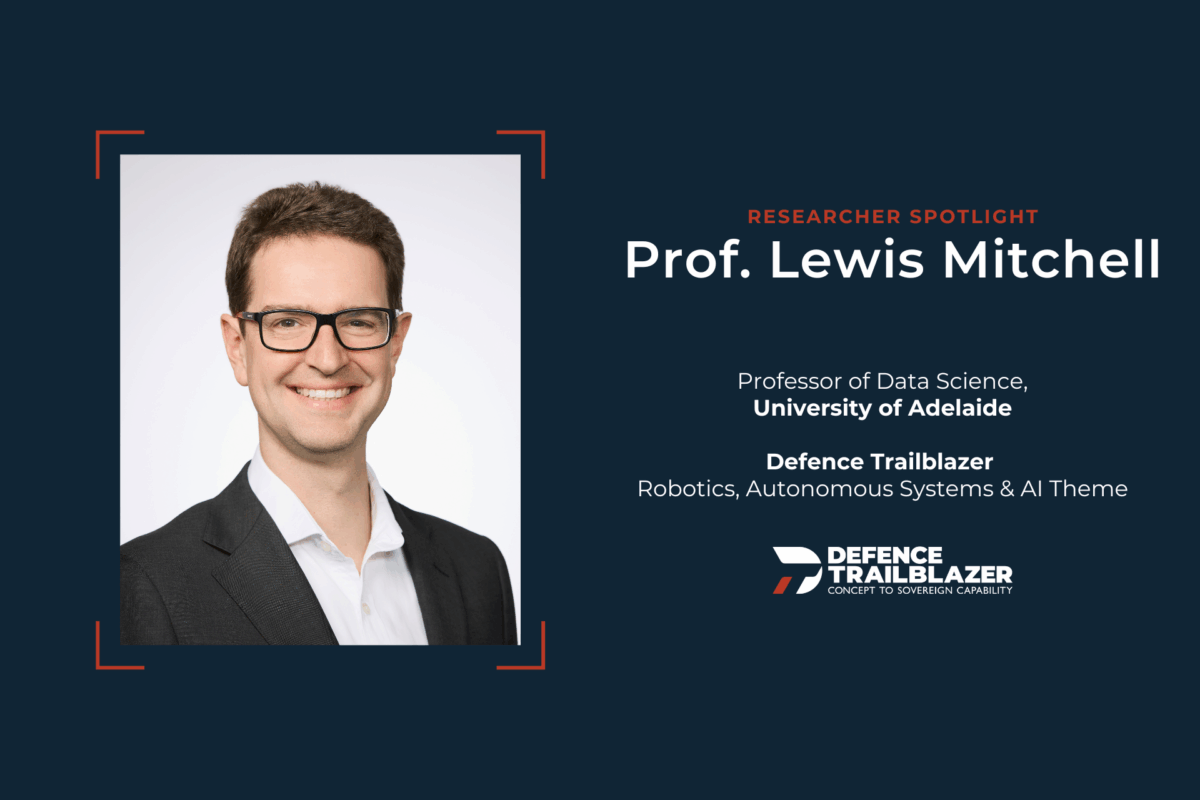
Professor Lewis Mitchell
Professor of Data Science, School of Computer and Mathematical Sciences, University of Adelaide
Defence Trailblazer Information Warfare & Advanced Cyber Technologies Theme
With a background in mathematical modelling, Professor Lewis Mitchell’s research interests cover a wide range of topics, from climate modelling to computational social science and human dynamics.
“I grew up trying to model physical systems, like weather and climate, and then I was gradually seduced into the world of data science and the study of people’s interactions,” said Professor Mitchell.
“I’m interested in how information flows over social networks and studying how online posts can lead people to influence each other on social networks.”
This interest catalysed Professor Mitchell’s involvement as the academic lead on two Defence Trailblazer industry-led projects with Fivecast and M&C Saatchi World Services.
Defence Connections
“Here at the University of Adelaide, we’re situated close to Defence Science and Technology Group, and there is a lot of interaction between the University, Defence and defence industry. Through these connections, I’ve become informed about some of the current national security challenges that Defence is addressing, including online misinformation.
When it comes to the misinformation that people encounter when engaging online, there are several questions of interest. Firstly, whether it comes from authentic sources, or from bots, and secondly, the purpose of the misinformation – for instance, if is there an intent to influence and to undermine.”
Understanding information flow
“Understanding how information spreads online through social networks is a great topic that lies at the intersection of data science, computer science and mathematical modelling.
The challenge with misinformation online is the ‘signal to noise’ ratio is low, so you need to wade through mounds and mounds of data to get anywhere.
When faced with large amounts of data, there’s a couple of ways that you can proceed. You can throw more and more computing power at the problem and use high-powered machine learning to sift through all the data, which is important and can get you far.
But if you want to do something predictive, or if you want to try and build in existing expertise from cognitive scientists, analysts or users, the reality is that you need models based on mathematics and statistics.”
Research capabilities at the University of Adelaide
Professor Lewis is the Director of the Adelaide Data Science Centre (ADSC) at the University of Adelaide, an interdisciplinary hub made up of experts in both statistics and mathematical modelling.
“From my perspective as a mathematically inclined data scientist, the capabilities that we bring include the power to reach answers more rapidly, and to build in more perspectives into methods of data analysis.
All the revolutions and quantum leaps in machine learning have come about because of mathematical or statistical insights that can make algorithms more efficient. That involves being able to look at data in new ways to extract new insights.
That’s what I hope that we bring and that’s the aim of these projects – to try and rapidly incorporate the modelling into actual tools. To be able to fail fast and iterate, and build from there.”
The benefits of industry collaboration
“My connection with Adelaide-based startup Fivecast goes back to its inception. I was involved with the Data to Decisions CRC, which Fivecast spun out of.
As a social media researcher, it’s become very difficult to get access to data for research. In the earlier days of social media, lots of data was readily available for academics, but that has dried up in the past few years.
A company like Fivecast works with open-source intelligence, which means it provides insights by analysing broad platforms of online data. For academics, partnering with such a company allows us to access data using their fantastic tools. That’s an immediate benefit for our ability to do research.
Even more importantly, it’s great to get a different perspective on research problems and to be able to achieve research translation quickly. Fivecast can help quickly transform our research into tools for end users, and that’s really powerful.
To be able to accelerate that pathway from research into application is one of the most exciting things about what we’re doing.”
The Defence Trailblazer approach
“Defence Trailblazer presented the perfect opportunity for me and the Fivecast industry leads to begin our formal collaboration.
Often the hard part about industry engagement is the long lead time for relationship-building and getting towards the stage of submitting a project proposal. From my perspective as a researcher, I think one of the best things that Defence Trailblazer has provided is the support in business development and project kick-off.
Most importantly, Defence Trailblazer brought all the parties to the table. It can sometimes be challenging for SMEs because they don’t have the amount of funding compared to a Defence Prime, but the co-funding structure of the Trailblazer R&D program has given us the opportunity to work together.
For the University of Adelaide, Defence Trailblazer has provided the capacity to hire a postdoctoral researcher and Masters student, and acquire the resources that we need to attack the research problem.
Defence Trailblazer has been a fantastic accelerator in helping to bring the project to life and supporting it through delivery. I’m incredibly grateful for all the people involved who have helped smooth the way.”
Background
Professor Lewis joined the University of Adelaide as a Professor of Data Science in 2014, after completing a Postdoctoral Fellowship in the mathematics of climate at the University of Vermont.
He was part of the Data to Decisions Cooperative Research Centre, which ran from 2014-2019, and has carried out data science research for diverse sectors, including the Centre for Invasive Science Solutions and the Grains Research and Development Corporation.
Professor Mitchell has been involved in numerous research collaborations for defence applications with DSTG and the ASCA program, exploring methods to understand and counter influence.
His awards include the ANZIAM JH Michell Medal for Outstanding New Researchers in 2021, awards in Outstanding Participation in Outreach and Outstanding Achievements Recognition from the ARC Centre of Excellence for Mathematical and Statistical Frontiers (ACEMS) in 2018, and the South Australian Young Tall Poppy Award from the Australian Institute of Policy & Science in 2018.