Defence Trailblazer is helping to shape the defence industry workforce of the future by embedding talented HDR students in industry-driven research projects, where they apply their skills to tackle real-world problems.
To date, the Industry Research Program has sponsored 28 Adelaide University and UNSW students to carry out research in defence industry priority themes, including quantum technologies, autonomous systems and hypersonics.
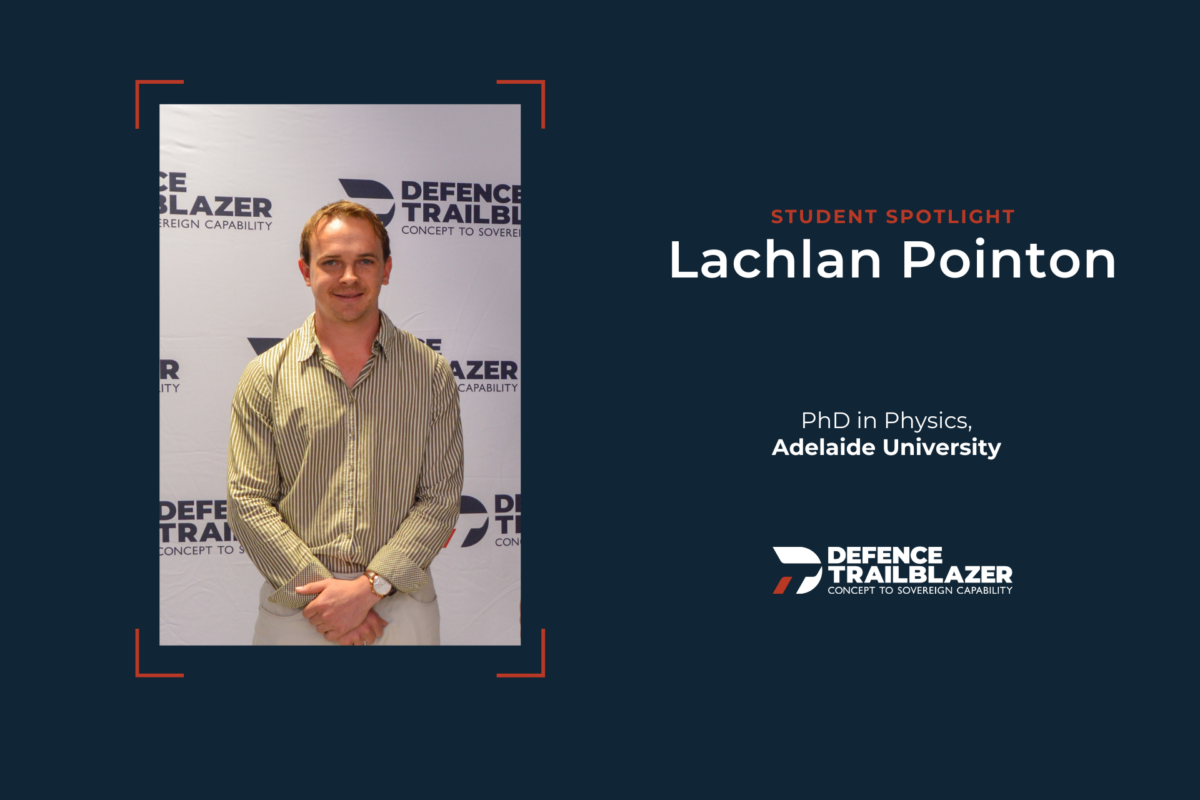
One such student is second-year PhD student Lachlan Pointon at Adelaide University, who carries out atomic and laser physics research in the Institute for Photonics and Advanced Sensing (IPAS) Precision Measurement Group.
Sovereign quantum expertise
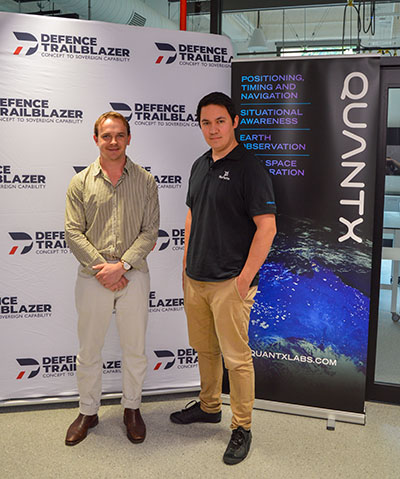
Lachlan’s PhD project focuses on developing the next generation of portable rubidium optical atomic clocks with industry partner QuantX Labs, an Adelaide University spin-out company that is fast becoming a world leader in precision timing and quantum technologies.
Optical atomic clocks use lasers to interrogate atomic transitions and are one of the most precise measurement tools ever built. QuantX Labs is developing a suite of atomic clocks that could be developed for global positioning systems, telecommunications, electricity networks, financial transactions and other terrestrial and space applications.
Atomic clocks could protect against GPS jamming or spoofing attacks, as they provide critical navigation and timekeeping capabilities in GPS-degraded environments. “Development of the next version of portable optical atomic clocks is vital to Australia’s defence industry and critical infrastructure,” said Lachlan.
Next-generation atomic clocks
The aim of Lachlan’s research project is to design and build a next-generation atomic clock that demonstrates improved performance and reduced size, weight and power requirements. “The vision is for the breakthrough developments to feature in the design of atomic clocks deployed on satellites in orbit,” said Lachlan.
“A potential for this technology utilises two-photon excitation of rubidium, which both Adelaide University and QuantX Labs have extensive experience in,” explained Lachlan. “I’m exploring novel techniques in the technical operation of this device to make them more frequency-stable and compact.”
Growing R&D capability between industry and academia

Lachlan is enjoying the benefits of working on a collaborative, industry-led project under the supervision of Dr Clayton Locke, Portable Atomic Clock Lead at QuantX Labs, and Professor Andre Luiten, IPAS Chief Innovator and QuantX CEO.
“QuantX Labs have provided access to a top-quality supervisor, high-performance lab equipment and specialised expertise unique to this arrangement,” said Lachlan.
“I have also gained valuable insights into the challenges and work undertaken in the private sector. It’s made me a better researcher.”
Lachlan is taking part in Defence Trailblazer’s inaugural Operation Thesis initiative and will be one of five finalists presenting their research to a wider Defence audience on 24 March 2026.